
KRONOVALL

The staff at the turn of the 20th century


The staff at the turn of the 20th century
A Living Story Through the Centuries
(Pre-1600s – 17th Century)
Long before Kronovall Estate was crowned by today’s elegant château, the site bore the imprint of a far older past. Archaeological findings suggest that the estate once hosted a medieval Danish stronghold, likely surrounded by water-filled moats—remnants of which still shape the landscape.
This early fortified structure is believed to have been destroyed during the turbulent conflicts of the 17th century.
The first documented owner was Sir Andrew Sinclair of Ravenscraig, born in Scotland in 1555 and deceased in 1625, was a nobleman of distinguished lineage who rose to prominence in the service of the Danish Crown. He served as a Royal Councillor of Denmark, envoy to England, and colonel, and was granted extensive estates including Kronovall, Gladsaxehus, Gislöv, Landskrona, Hammershus, and Sincklarsholm near Hässleholm. In Denmark and Sweden, he became widely known under the name Anders Sincklar (also rendered Sinklar or Sinclar).
Sinclair took part in the Kalmar War as a captain and was involved in the Danish conquest of Öland. He retained possession of Kronovall until his death, while the estate of Sincklarsholm was completed only posthumously.
From Danish Noble Seat to Swedish Estate (1668–1760)
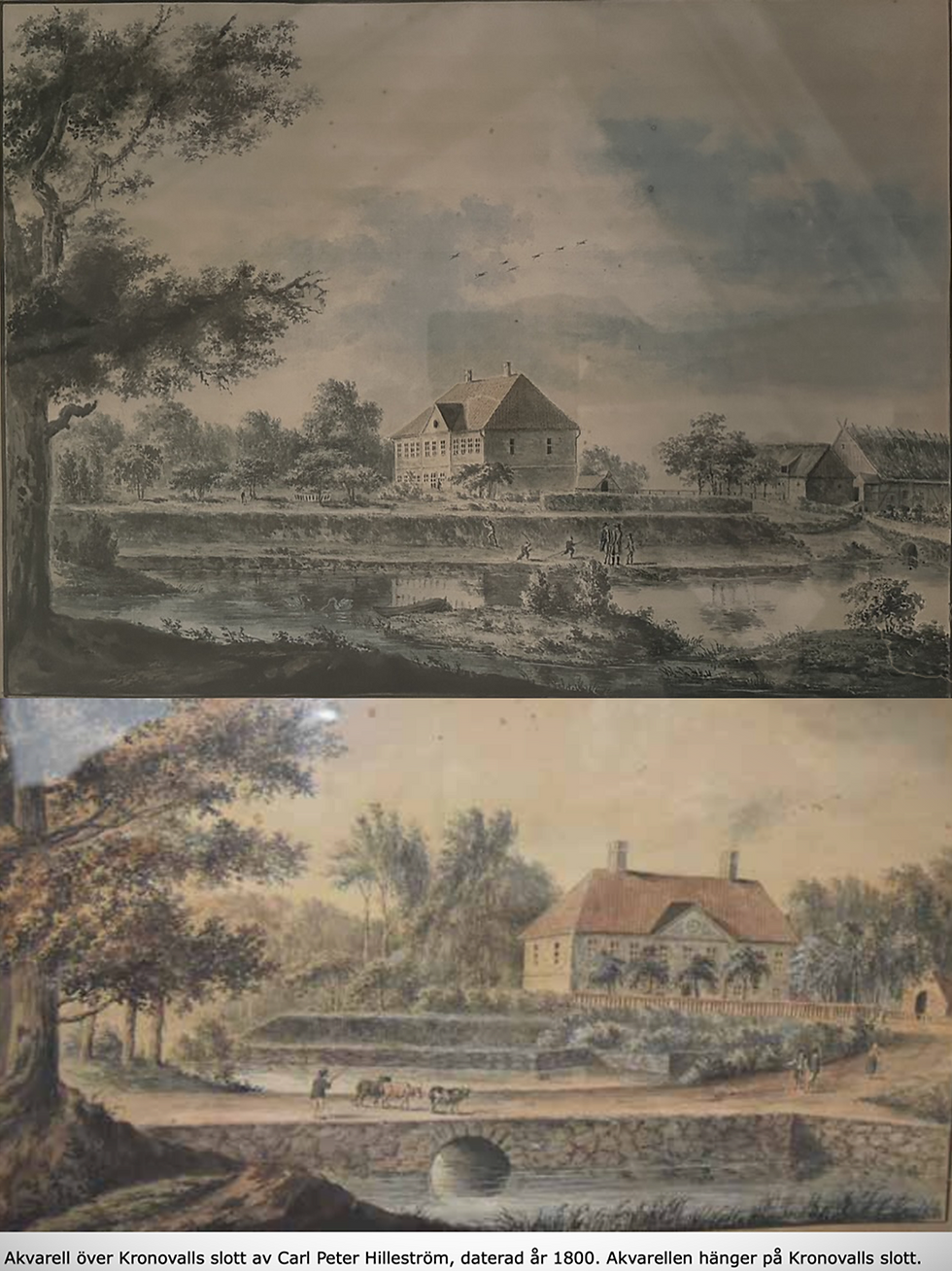
Kronovall Castle traces its origins to the 18th century, though the estate itself holds deeper historical roots shaped by both Scottish, Danish and Swedish nobility. Situated in a region long influenced by shifting borders and aristocratic ownership, the estate developed as a seat of rural prominence. Early structures on the site reflected a more modest manor, gradually evolving under successive noble families who contributed to its agricultural and cultural significance.
The Age of Noble Ambition
(1769–1875)
The estate was subsequently established as an entailed property, ensuring its preservation within the noble lineage across successive generations—from the von Essen af Zellie family to the Hamilton family in 1769.
Throughout the late 18th and early 19th centuries, Kronovall remained a dignified yet relatively understated estate, reflecting the agricultural traditions and social structures of its time.
A Vision of Grandeur
The Transformation Begins
(1875–1892)
In 1875, the estate was inherited by Alexandrine Hamilton, a young noblewoman with bold ambitions. Inspired by the aristocratic trend of transforming estates into grand palaces, she envisioned Kronovall as a residence of international stature.
Several renowned architects were commissioned:
-
Helgo Zettervall (1877) – proposed a dramatic, turreted castle in asymmetrical design
-
Mauritz Frohm – offered a more restrained alternative
-
Henry Ernest Milner (Great Britain) presented a further grand proposal. None of these plans, however, were ever fully realised. Elements of the park’s design at Kronovall are believed to reflect Milner’s ideas.
In 1899, Milner was awarded the Swedish Order of the Polar Star in recognition of his work with the Royal Gardens of Sweden.



The Birth of Kronovall Palace
(1892–1896)
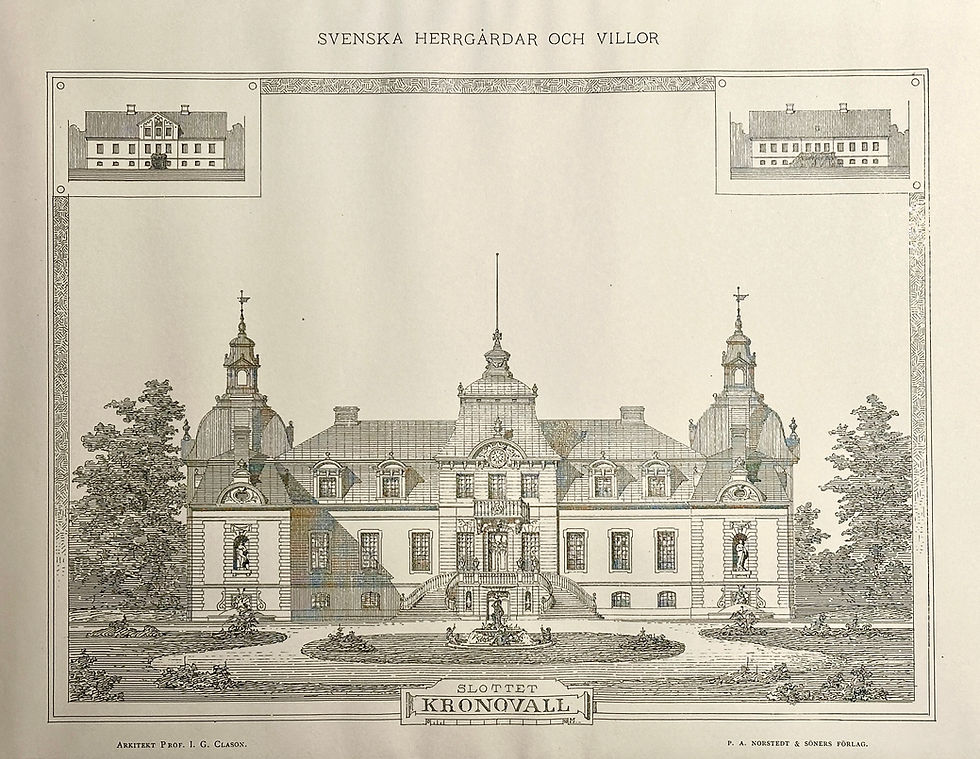
The transformation finally materialized under the direction of Isak Gustaf Clason, one of Sweden’s most influential architects of the era.
Beginning in 1892, Clason reimagined Kronovall as a Baroque-inspired château, drawing on the grandeur of Sweden’s 17th-century great power era.
Key features of the transformation included:
-
Addition of two prominent wings and corner towers
-
A dramatic double staircase entrance
-
A mansard roof clad in slate
-
Lavish interiors with grand salons, library, music room, and dining halls
-
Installation of modern innovations such as elevators, heating systems, and advanced window technology
The estate was also redesigned externally, with formal gardens and planned water features. By 1896, Kronovall stood complete—a modern castle of its time, combining historical inspiration with cutting-edge comfort.
Life and Early 20th Century Evolution
(1896–1937)
Following its completion, Kronovall became a vibrant aristocratic residence. Contemporary accounts describe richly decorated interiors filled with art, marble, gilded ornamentation, and family portraits stretching back centuries.
By the early 20th century, the estate functioned as a self-sufficient domain, with extensive agricultural buildings, workshops, and staff residences — at one point totaling over 30 structures.
Modernization and Change
(1937–1960s)
In 1937, a significant modernization took place under the Sparre family:
-
Installation of new bathrooms and updated utilities
-
Electrical and heating improvements
-
Interior reconfiguration and updated décor
-
Re-coloring of façades and roofs
This period marked the transition from aristocratic residence to a more modern, functional estate, adapting to changing lifestyles. Later, in the 1960s, further modifications were made, including the subdivision of certain grand rooms into more practical living spaces.
From Residence to Cultural Institution
(1991–2014)
With no direct heirs, Erik and Angelica Sparre transferred Kronovall in 1991 to a foundation managed by the House of Nobility (Riddarhuset), ensuring its long-term preservation.
In 1996, the estate entered a new era when it was leased and transformed into a wine château:
-
Hotel and conference facilities were established
-
A restaurant and wine tasting experience introduced
-
Major renovations restored key interiors, including the grand dining hall
Kronovall became a destination blending heritage, gastronomy, and hospitality.


Recent Years and a New Chapter
(2014–Today)
Following a period under various ownerships and stewardship leading up to 2024, the estate entered a new phase of transition—marked by careful restoration, authentic reinterpretation, and forward-looking development.
Today, Kronovall stands at the threshold of a new era under the guidance of the von Braun family—Torbjörn von Braun and Hanne Coll-Hansen von Braun, together with their three daughters and sons-in-law. Their vision is rooted in the preservation of cultural heritage, combined with thoughtful entrepreneurial development, where quality, design, and meaningful experiences—shaped by a sense of wellbeing and quality of life—are at the forefront.
With half a millennium of history embedded within its walls—from medieval stronghold to aristocratic residence, from modernised estate to cultural destination—Kronovall remains a place where history is not only preserved, but continuously reinterpreted in harmony with the opportunities of our time.
A Living Estate
Kronovall is more than a fortified castle turned into a Baroque château or palace inpired by Sweden’s great power era. It is a timeline in stone, landscape, and memory—a place where each generation has left its mark, and where the next chapter is already beginning.
Top Heritage Kronovall AB
Kronovalls Slott
273 92 Skåne - Sweden
info@kronovall.com
Follow our journey on social media:


© 2025 by Kronovall. All Rights Reserved
Contact Restaurant:
